
SmileFy helps dentists and patients visualize outcomes with the Spatial Reality Display
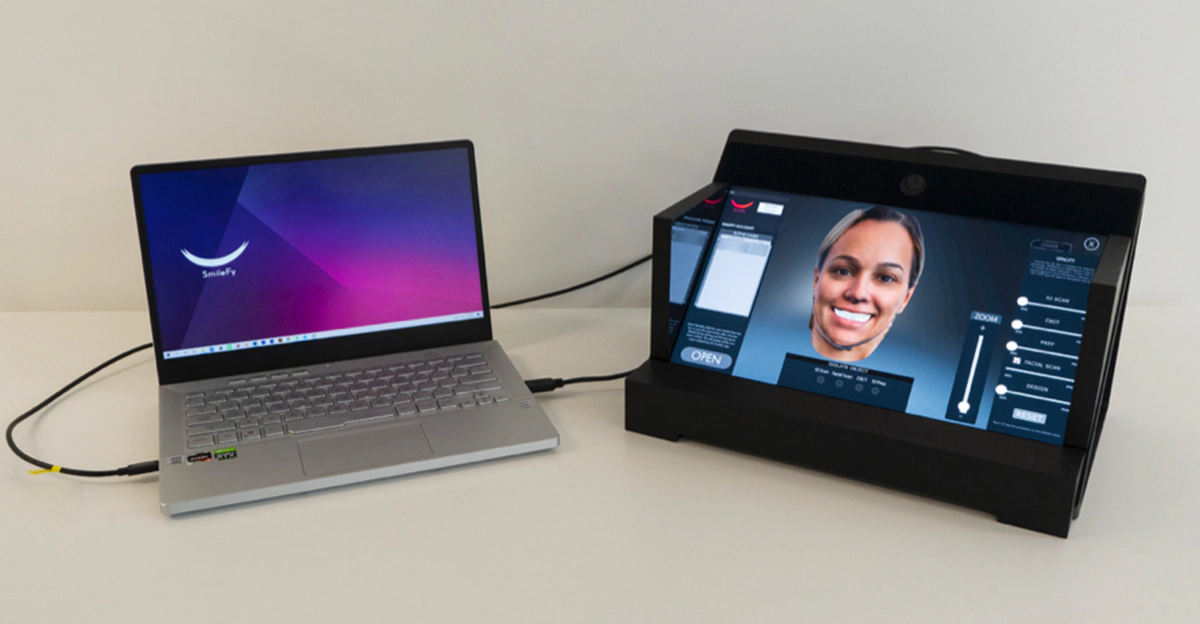
“How will I look?” ask patients in need of restorative or cosmetic dentistry. Now dentists can provide an authoritative answer with SmileFy’s visualization software and the Sony Spatial Reality Display.
How we helped

The challenge
- 2D presentation admits too much uncertainty for patient and dentist alike.
- 2D presentation leads to less predictable results, requiring too many adjustments.
- Outsourced 3D mock-ups are slow, expensive and cannot be adjusted on the fly.

The solution
- Combine views from patient digital files: CBCTs, digital impressions, facial scans.
- Empower the dentist with the SmileFy design app and the Spatial Reality Display1.
- Enable the patient to preview the design in interactive, volumetric 3D2.
*1 Computer required with a recommended CPU of Intel Core i7-9700K @3.60GHz or faster; and a graphics card such as NVIDIA GeForce RTX 2070 SUPER or faster.
*2 See instruction manual accompanying the product for details on product use, incl. 3D feature.

The outcome
- Expected to reduce patient “chair time” and accelerate smile design.
- Expected to increase “try-in” as patients see a more accurate, more persuasive preview.
- Expected to make results more predictable, reducing the need for adjustments.
Spatial Reality Display - Where Imagination Becomes Reality
Spatial Reality Display – SmileFy Dental Demo
Spatial Reality Display Product and Purchase Information
Quotes:
"Our dentists are super excited. 3D enables the most accurate treatment plan possible."
- Ralph Georg, CEO & founder, SmileFy
A new dimension in smile design and display
There was a problem with restorative and cosmetic dentistry, Ralph Georg, CEO & founder of SmileFy, understood. The workflows were far too time consuming. The results were far too uncertain. And the patient buy-in to treatment programs was far too hit-or-miss. Georg applied the latest digital tools to create the app that would become SmileFy. According to Georg, “Dentists deeply appreciate how our tools empower them to design, present and implement treatment plans faster and better. But until now, we were always limited by 2D display.”
“We humans are exquisitely sensitive to subtle differences in the shape of smiles – and the way smiles interact with the shape of the face,” says Georg. “2D presentation can never convey all those subtleties. So when Sony demonstrated high-resolution glasses-free 3D with the Spatial Reality Display, we jumped at the opportunity.”
Glasses-free 3D
The Sony Spatial Reality Display enables viewers to see volumetric 3D without special glasses or VR goggles2. The display works from computer generated images, in the case of SmileFy, using a Windows PC running the Unity game engine software3. The display features a high-precision micro-optical lens to separate the left-eye and right-eye images. In addition, the display tracks eye movement down to the millisecond, pivoting the image in sync as the viewer tilts or moves the head up and down, left and right—even forward and back. The result is an overpowering sensation of a solid 3D object.
Support for the Spatial Reality Display will be available to SmileFy Gold Plan subscribers at no additional charge.
*3 Recommend use of “high resolution, quality images” created using Unity or Unreal software.
Transforming restorative and cosmetic dentistry
The SmileFy process begins with digital patient files, including conventional photos, 3D facial scans and Cone Beam Computed Tomography (CBCT) scans. After the image capture, the SmileFy app enables the dentist to design a smile, taking into account face shape and asymmetries as well as specific patient requests and concerns. The result is a digital mock up that the dentist can show the patient for review and approval of the treatment plan. “It can take up to ten business days to get a traditional, outsourced mock up,” says Michelle Carpio, partnership development manager at SmileFy. “And each design change needs to be sent back to the lab. With the 3D digital doppelganger, changes can be made with a few clicks.”
Carpio expects the display to make a huge difference when the dentist proposes a treatment plan. She says, “Dentists are telling us they anticipate getting the green light from more patients because the 3D is so persuasive. The potential is obvious.”
Ralph Georg is already looking toward the future. “In the long run, 3D is going to change not just presentation, but also treatment. This is going to change everything. It’s a new standard of care.”