Preserving Finite Resources for Future
Generations
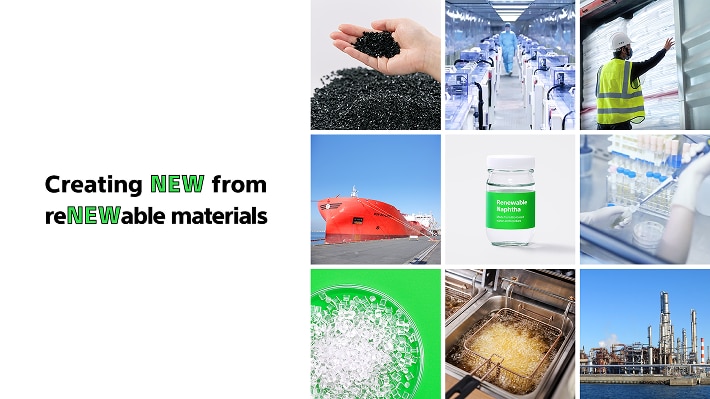
To expand the use of renewable feedstocks that make effective use of biomass (such as waste cooking oil), we personally visit production sites to verify their production processes.
Further, to ensure that the certified renewable feedstocks allocated to our products are properly documented, we have made our entire supply chain not only transparent, but fully traceable through a mass balance-based chain of custody. Conserving finite resources for future generations—that is the root of our challenge.
Transitioning from Petroleum to Renewable
Resources
Renewable materials are derived from renewable resources, such as plants, which can be replenished naturally, instead of finite resources like petroleum.
By utilizing underused or waste-derived materials as feedstock inputs, the horizons of renewability will continue to expand.
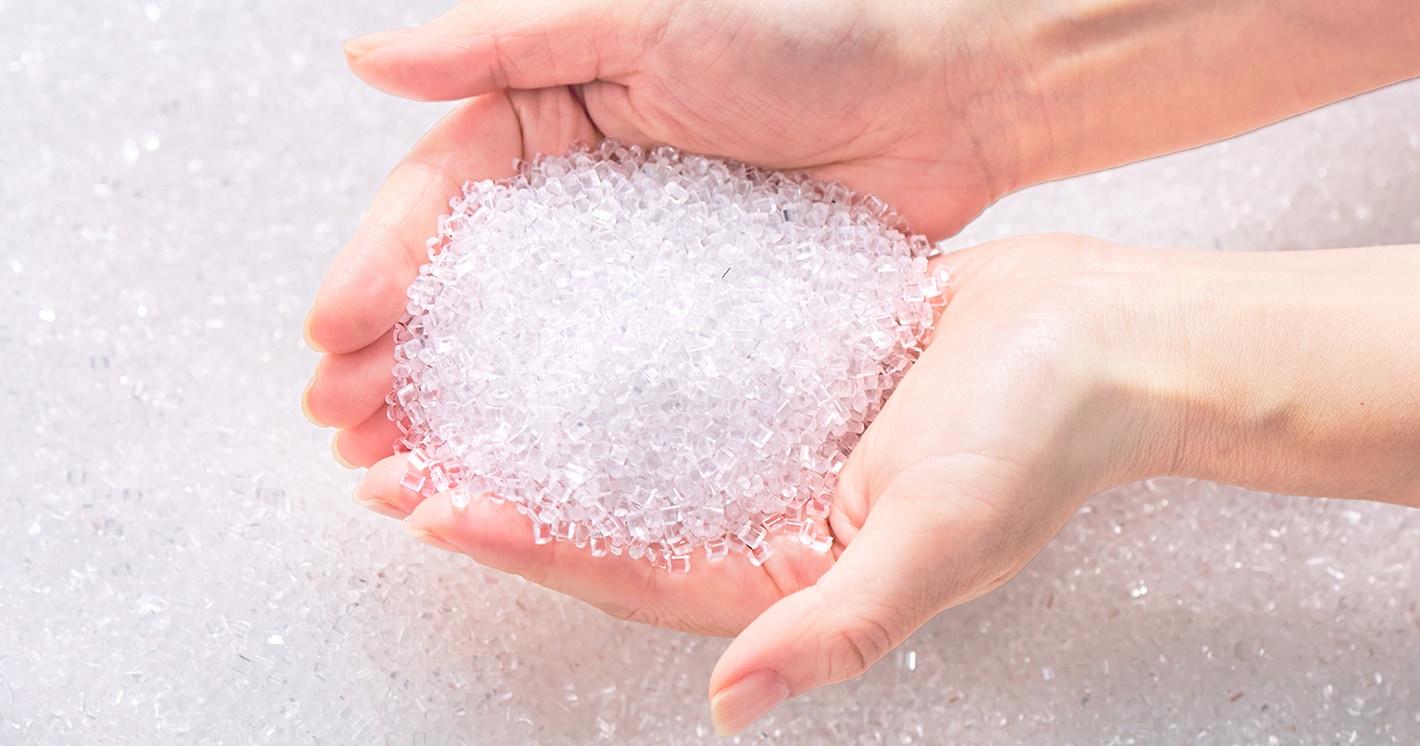
For this initiative, we have introduced plastics to which an equivalent amount of bio-based feedstock, such as used cooking oil, is allocated and documented through a mass balance approach.
Rather than relying on fossil resources such as petroleum, we use plastics manufactured using a mass balance approach in which renewable, biomass-derived feedstocks are allocated—an approach that supports more sustainable use of resources. This represents a first concrete step in selecting materials to reduce environmental impact.
Making the Supply Chain Visible
Where do raw materials come from, and how do they become finished products? Working with Mitsubishi Corporation, a company with strong capabilities in material procurement, we have made our entire supply chain transparent, beginning with renewable, biomass-derived feedstocks. By sharing the complete supply pathway—from suppliers of chemical feedstocks to producers of resins and flame retardants, and ultimately to our own finished products—we aim to build social trust and support the broader adoption of renewable materials.

① Production of renewable naphtha — Neste Corporation / ② Production of renewable styrene monomer — Idemitsu Kosan Co., Ltd. / ③ Production of renewable polystyrene resin — Formosa Chemicals & Fibre Corporation / ④ Production of renewable para-xylene — SK Geo Centric Co., Ltd. / ⑤ Production of renewable para-xylene — ENEOS Corporation / ⑥ Production of renewable terephthalic acid — Hanwha Impact Corporation / ⑦ Production of renewable PET resin — Toray Advanced Materials Korea Inc. / ⑧ Production of renewable bisphenol-A — Mitsui Chemicals, Inc. / ⑨ Production of renewable polycarbonate (PC) resin — CHIMEI Corporation / ⑩ Production of renewable flame retardants — ADEKA CORPORATION / ⑪ Production of renewable PC/ABS resin — Qingdao Haier New Material Development Co., Ltd./ ⑫ Molding manufacturers / ⑬ Design and manufacturing of finished products — Sony Corporation
A First Step Toward
Replacing Plastics with
Circular Materials
Under the mass balance system, the mixture of renewable and conventional fossil-based feedstocks is strictly managed, and the certified renewable share is carefully quantified through bookkeeping. While conventional resources cannot be completely replaced with renewables overnight, this approach allows us to demonstrate exactly how much renewable input we have introduced, while leveraging existing facilities to deliver renewable resources more quickly and at lower cost.

Crucially, the plastics produced by this approach are equivalent in performance to conventional fossil-based products. There is no compromise in properties such as strength, light transmittance, or processability, and the materials can be integrated into existing recycling schemes. By gaining visibility into and verifying the use of renewable resources throughout the entire supply chain, we can better understand how these materials are sourced and managed without compromising product performance.
Products That Give Form to the Future
The various renewable plastics produced through this supply chain are scheduled for future use in Sony's global audio-visual products.
Our aim is for people to experience the value of circular materials through the products they use on a daily basis.
Taking on the "Road to Zero" Challenge
Sony is pursuing its "Road to Zero" environmental plan with the goal of achieving zero environmental impact by 2050. Under this plan, we aim to achieve net-zero greenhouse gas emissions by 2040, with the further goal of reaching zero new use of prioritized resources by 2050. Application of the mass balance method and utilization of renewable materials are key steps along this path. Reducing environmental impact at every stage, from resource extraction and manufacturing to logistics, use, and disposal, we are contributing to the development of a circular society. Through steady progress on these challenges, we aim for a zero-impact future.

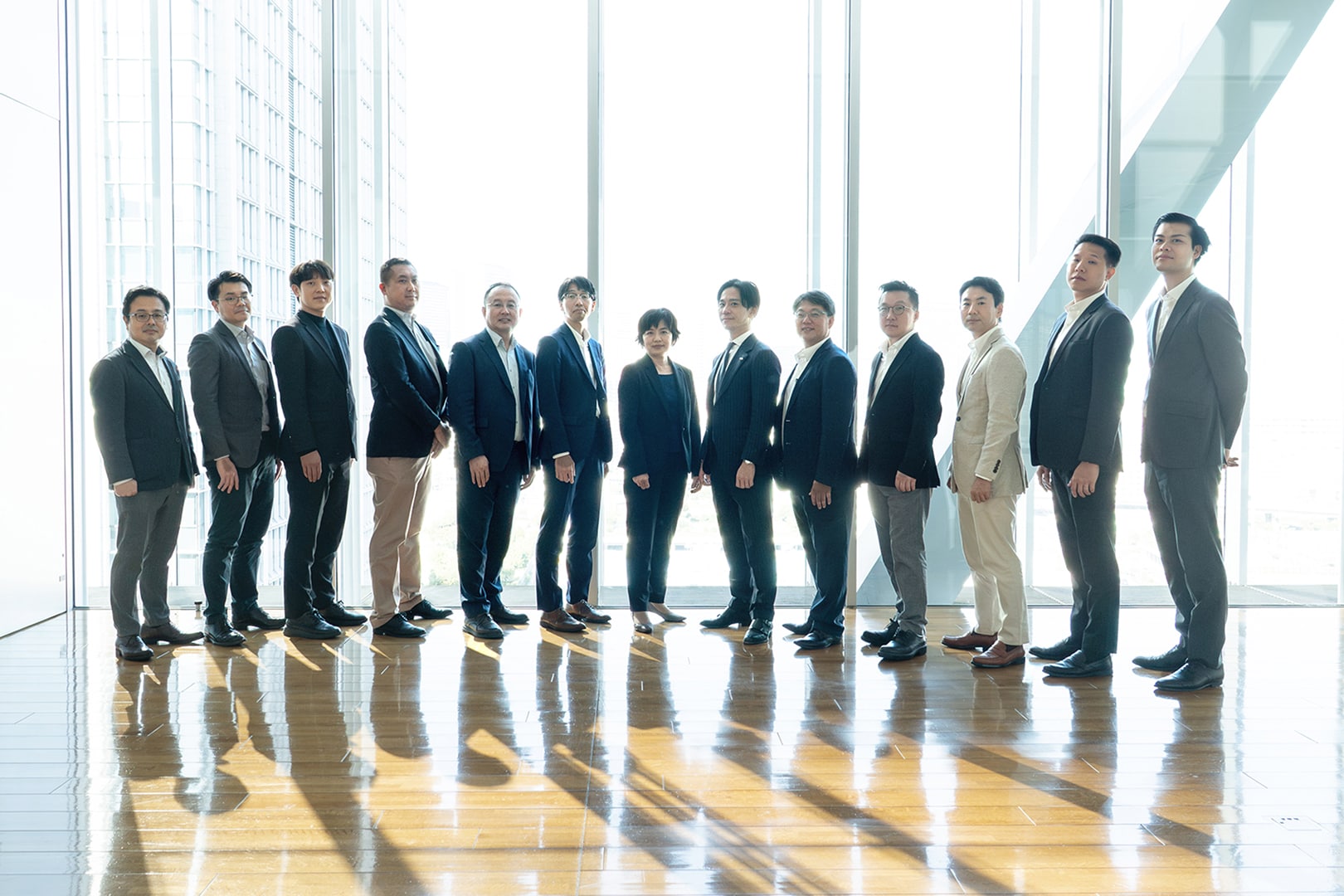
Interviews with Project
Members

Hisaoki Oba
Sustainability Working Group and MechanicalStrategy Committee, Technology Strategy
Committee, Sony Group
As part of the "Road to Zero," we aim to eliminate the use of petroleum-derived virgin plastics by 2050. To achieve this, we regard the use of renewable plastics as essential, as material recycling alone cannot meet the needs of high-performance components. Although challenges such as cost and supply remain, we are promoting an industry environment that makes such materials easier to adopt, while gaining hands-on experience using them ourselves.
Junichiro Ono
Team Leader, Marketing & Intelligence Team,Ecological Material dept, Material Solution Group,
Mitsubishi Corporation
With the support and cooperation of many partners, we have built a supply chain that further reduces environmental impact while maintaining Sony's high quality standards. This ambitious project involved rigorous discussions—beginning at the feedstock stage—on what materials are best suited to a decarbonized society. It also included on-site visits and cross-industry collaboration to turn those ideas into reality.