Current

Sony Corporation


The Department of Photography (DOP) at Nihon University College of Art is proud to present Sky VIII, the eighth installment of this annual exhibition featuring works by full-time faculty members.
The four exhibiting faculty members have honed their craft by rigorously studying foundational techniques under the guidance of their own mentors. Building on this solid foundation, they continue to research and practice photographic expression as they pursue the development of their individual artistic voices.
As educators, they engage daily with a diverse community of students, gaining continual exposure to the wide-ranging world of photography. Through this ongoing process of dialogue, exploration, and experimentation, they challenge themselves to embrace and cultivate new and varied forms of photographic expression.
This exhibition introduces the work of four faculty members who, while dedicating themselves to teaching within the Department of Photography, also maintain active creative practices with the presentation of their work in mind.
Yushi Koike joined the Department of Photography as an assistant professor this year. With professional experience in the advertising and printing industries—where he worked in retouching, product development, and related areas—he possesses extensive expertise in image processing. Since his student days, Koike has explored the relationship between people and the regions they inhabit, developing multiple long-term projects simultaneously and constructing his work over extended periods of time.
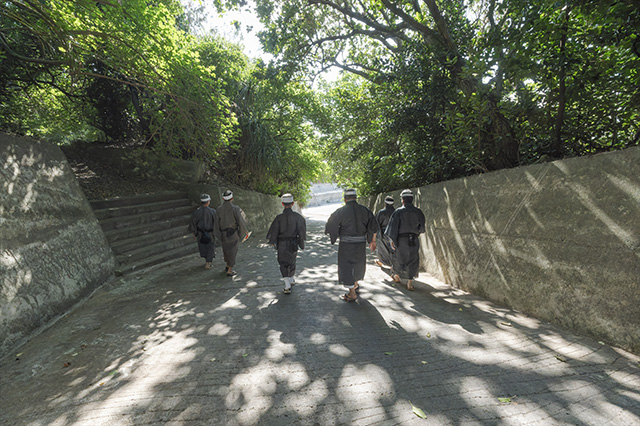
The series Kaeru Michi (The Path of Return), presented here for the first time, began with his curiosity about a shrine he encountered by chance—one with a particularly unusual history. By continuing to photograph the site over time, Koike documents the transformations of the land itself, gradually revealing the memories inscribed upon the place.
Kazuto Hattori appears in this exhibition for the fourth time, returning after a two-year interval. With professional experience ranging from the advertising industry to the field of documentary photography, he has traveled extensively across the world in pursuit of his work.
In this year's exhibition, he presents Scenes with Steam Locomotives, a series that captures the atmosphere and character of steam locomotives woven into everyday life—subjects no longer seen in Japan since their disappearance from daily use. Hattori traveled to developing countries and photographed steam locomotives operating in ordinary settings far removed from tourist routes, portraying their presence with a sense of authenticity and warmth. Created through impressions gained only by being physically present on location, this work represents a foundational expression of Hattori's deep affection for trains.
Satomi Tanaka returns for the fifth time, following his participation in last year's exhibition. Having taken part in the very first SKY exhibition, Tanaka now presents 35×35 — A Journey in the History of Photography II, an extension of his earlier "History Series," created over the span of eight years.
In this project, Tanaka follows in the footsteps of Eugène Atget—a photographer he deeply admires—by limiting himself to a single, minimal set of equipment: a 35mm film camera paired with a 35mm lens. Traveling to well-known sites in the history of photography, he documents their present-day appearance through this restrained and deliberate approach. Places where significant moments once unfolded remain profoundly quiet even today, and Tanaka's photographs convey the enduring stillness that lingers in these historically charged landscapes.
Motoharu Yagi returns for the third time, appearing again after a two-year interval. After honing his skills in the field of architectural photography, he went on to engage in education. While possessing the technical ability to work across a wide range of subjects—from people to landscapes—Yagi continues to pursue architectural themes as a central part of his lifelong practice.
In this year's exhibition, he presents KAMABOKO STRUCTURE, a series inspired by the distinctive arch-shaped ("kamaboko") buildings found in his home prefecture of Niigata. Through this work, he examines the relationship between the local landscape and these regional architectural forms. The series conveys the functional beauty born of wisdom and experience unique to heavy snowfall regions, expressed not only through the photographs themselves but also through the method of display.
Photography is an art form that can only be created by being physically present at a given moment, capturing an instant that will never occur in the same way again. Yet, the process of making photographic work often unfolds over long periods of time. As the years pass after a photograph is taken, the image itself may acquire a depth—an aging or maturation—that differs from the changes in the actual passage of time.
These four photographers present original prints that they have meticulously crafted, paying close attention to every aspect of the process—from capture to final finish. Despite their primary roles as educators, they have continued to pursue their creative practice with steady dedication. I warmly invite you to experience the breadth and depth of their photographic expression, not only through the imagery itself but also through the methods of display.
In closing, I would like to extend my heartfelt gratitude to everyone who has taken the time to visit this exhibition, as well as to the team at Sony Imaging Gallery for providing us with this valuable opportunity.


About ten years ago, I was given the opportunity to travel through several countries in Europe and the United States over the course of about three months. Since my university days, I had been deeply interested in the history of photography, and whenever I encountered historic images attached to archival documents, I found myself longing to visit those very places where history had unfolded. With the excitement of finally realizing that long-held desire, I began my journey in Rochester, New York, and went on to visit twelve cities across six countries in Europe and America.
During this journey, I carried two cameras—one film and one digital. Each was fitted with a single 35mm prime lens. I photographed primarily with the film camera, using the digital camera only as a backup. For this exhibition, all of the works on display were photographed exclusively with that film camera and 35mm lens combination.
I brought with me eighty rolls of 35mm film, consisting of five types made by major manufacturers, all prepared in Japan before my departure. I chose not to purchase film locally—even though carrying so many rolls added weight to my luggage—because I wanted to test how much airport X-ray inspections would affect the film. With the understanding that the images might become completely unusable, I placed all the rolls inside my camera bag and sent them through the inspection machines. In total, they passed through X-ray screening fourteen times. I was somewhat surprised to find that, despite this, the negatives still produced printable images.
Another theme I wanted to explore was the idea of creating an entire body of work using a single camera and a single lens. This desire dates back to my student days, when I first learned about the photographer Eugène Atget. Atget spent his life photographing with nothing more than one 180mm lens. This series is also an expression of my own admiration for him.
Satomi Tanaka


I have loved railways since childhood, spending countless hours riding trains and photographing them.
My interest, however, has never been in the locomotives themselves, but rather in the atmosphere surrounding them—the natural landscapes, the environments through which they pass, and the everyday lives of the people who use them. What drew me in was not anything extraordinary, but the quiet charm of railways woven naturally into the rhythms of daily life.
There was a time when steam locomotives still operated in Japan, but as a child I had few chances to see them before they disappeared.
When I later learned, as an adult, that there were still several countries where steam locomotives continued to run as part of everyday life, I began traveling to those places from time to time, savoring the unique atmosphere they embodied.
In most cases, the countries where steam locomotives still operate are those often described as developing nations, and the towns they run through tend to be remote and rural. These places are neither tourist destinations nor sites of special interest, and it is rare to see foreign travelers there. Had it not been for the steam locomotives, I likely would never have visited them in my lifetime. Yet it was in these out-of-the-way places that I encountered a rich and memorable atmosphere.
Many of these photographs were taken before the internet had become widely accessible. Information about distant regions was scarce and unreliable, and even after finally reaching a destination, I often found that it fell short of my expectations, leaving the journey feeling fruitless.
And yet, looking back now, I feel differently.
Unlike today—when we search online before traveling and examine the surroundings on Google Maps again and again—I remember fondly the excitement of not knowing what awaited me, or what kind of place I was about to encounter. That sense of anticipation, born from uncertainty, is something I miss.


There is a peculiar flow of time in this shrine, which lies surrounded by forest.
The sanctuary, once located atop the mountain, lost its place when the land was reshaped for a quarry. Years later, after the quarry had vanished, it was brought back to this site once more.
As the shrine was altered by human hands, abandoned when its purpose was deemed complete, and eventually called back again as a "sacred place," I found myself wondering:What expression do the memories held by this land wear through such constant shifts?
Ten years ago, when I first visited, a brand-new shrine stood alone in the middle of the abandoned quarry.
No matter how many times I returned, I never encountered another person—only the wind and the light quietly drawing forth the history that lingered in this place.
Ordinarily I would delve into the origins of the land, yet here I felt no such impulse. Instead, I was met with an inexplicable pull, a gravity that defied explanation.
The leveled ground has since grown over with grass, and in summer it is swallowed by a deep green.
Whether this place is in the midst of changing or in the process of returning to what it once was, even the land itself seems unsure.
In Japan, it is not uncommon for old structures to be torn down and for land that has fulfilled its purpose to be quickly pushed toward its next use.
The history of this shrine is merely one fragment of that wider pattern.
And places facing a similar fate are not unique to this site—they lie quietly scattered across the country.
Mountains are carved away, villages are reshaped, and the memories once held in those landscapes are buried in the earth, unknown to anyone.
Many people may be able to recall somewhere within their own communities that shares this same quiet destiny.
For this reason, recording this shrine is not merely the documentation of a single place.
Through the existence of land that is fading from memory, of histories swept aside, and of sites that were still able to "return," I hope viewers will be able to project their own thoughts onto the places that live within their memories and in the landscapes familiar to them.
Within your heart, too, there is surely a place that once existed—one that has changed its form over time, its very name now growing faint.
I hope that this record of the shrine might serve as a prompt to recall those traces.


1474 cm.
This number represents the total annual snowfall recorded in a certain region of Niigata Prefecture. Areas where winter snow accumulation reaches such extreme levels are designated as Special Heavy Snowfall Zones—and several of these zones are scattered throughout Niigata.
Such regions are home to distinctive architectural forms, one of which is the kamaboko-shaped structure. These buildings are commonly found in the snowiest areas of Niigata Prefecture, though their official name is unclear. However, they have frequently appeared as motifs in works exhibited at the Echigo-Tsumari Art Triennale, making them an architectural form that can be considered highly iconic to Niigata.
Their uses vary widely: they serve as bus stop shelters, storage sheds or garages, places to keep farm equipment, simple workspaces, areas for drying crops, unmanned roadside stands, and even local volunteer fire brigade posts. These structures can be found beside private homes, at front entrances, at the edges or centers of fields, along footpaths between paddies, and on mountain passes—whether prefectural roads, municipal roads, or private lanes. In every case, they appear closely woven into the fabric of daily life.
These structures share a common characteristic: a half-arch roof designed so that, once a certain amount of snow accumulates, it naturally slides off onto the ground.
The curved form, much like an arched truss bridge, distributes weight efficiently and creates a highly durable structure capable of withstanding heavy snowfall—an entirely rational shape adapted to the local climate.
Amid the pure white landscapes of the heavy-snow regions, the repeated appearance of these buildings—at once slightly out of place yet quietly unadorned—has continued to draw me in and compel me to photograph them.
By documenting these everyday structures through the methods of architectural photography, I found that I could observe their value from a more neutral, distanced perspective.
The visual beauty created by the distinctive form of the kamaboko structure is, in itself, an expression of functional design.
And that functional beauty clearly reflects the climate and conditions of this region.
As I continued to follow these buildings and photograph them time and again, I was reminded—almost anew—of the harshness of the environment that forms part of my own origins.